How to switch careers without starting over

Thinking about a career change? Good. But you don't need to blow up your life to do it. Here's the practical playbook for making a move — from someone who's helped a lot of folks do exactly this.
Here's what most career change advice sounds like: "Follow your passion! Take the leap! The net will appear!"
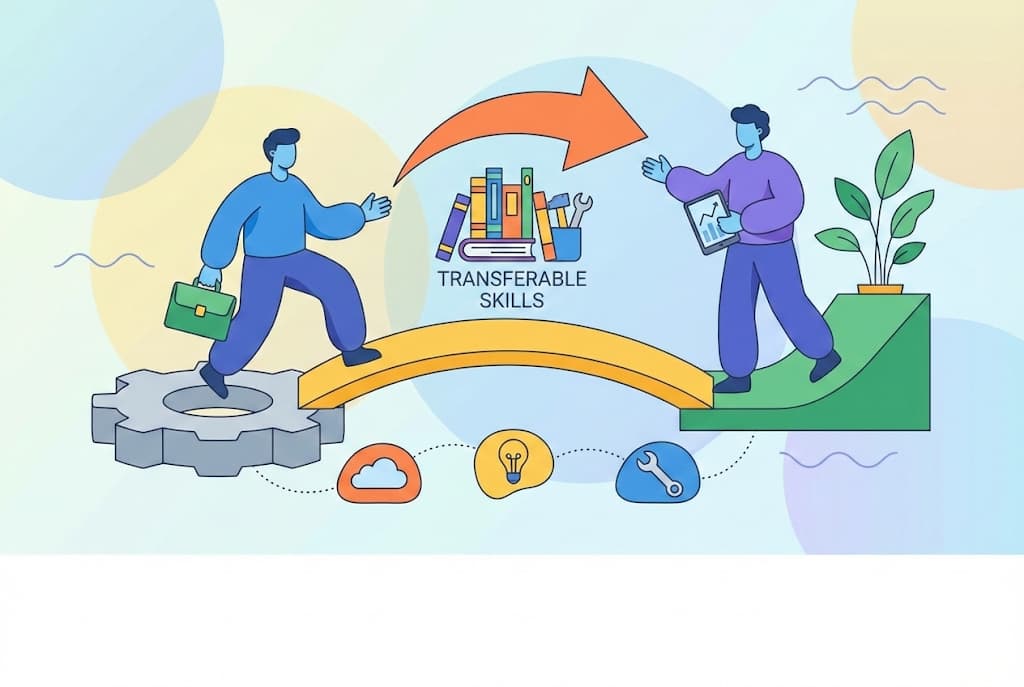
And here's what most career changers actually need to hear: you don't need a leap. You need a bridge.
The idea that switching careers means starting from scratch is one of the most damaging myths in the working world. It keeps smart, capable people stuck in jobs they've outgrown because they're terrified of losing everything they've built.
You won't lose everything. In fact, you'll bring most of it with you. You just need a plan.
Why career changes feel scarier than they are
Career transitions trigger a very specific kind of fear — the "I'm going to throw away ten years of experience and become an entry-level nobody" fear.
That fear is understandable. And it's almost entirely wrong.
Here's why: careers aren't ladders anymore. They're lattices. The skills, relationships, and credibility you've built in one field don't disappear when you move to another. They translate. Sometimes directly, sometimes with some creative positioning — but they translate.
The project manager who switches to operations management isn't starting over. They're applying the same core competencies — organization, stakeholder management, problem-solving — in a different context.
The teacher who moves into corporate training isn't starting over. They're bringing years of curriculum design and presentation skills to a new audience.
The thing that changes is the context. The thing that stays is you.
Step 1: Figure out what you're actually running from (and toward)
Most folks who come to me wanting a career change are running from something specific: a bad boss, a boring industry, a role that doesn't match their values, a compensation ceiling.
That's a valid starting point. But it's not enough.
Because if you only know what you're running from, you'll end up somewhere equally wrong — just in a different flavor.
So before you do anything else, get clear on both sides:
What's driving you away? Be specific. Is it the role itself, or the company? Is it the work, or the culture? Is it the industry, or just your corner of it? I've worked with folks who thought they needed a whole new career when what they actually needed was a different boss or a different company. That's a much simpler fix.
What are you moving toward? And "anything but this" doesn't count. Think about: What kind of work energizes you? What topics can you talk about for hours without getting bored? When do you feel most competent and confident? What does a good day at work look like?
If you're struggling with the "toward" part, try this exercise: for two weeks, keep a simple energy log. At the end of each day, write down the tasks that drained you and the tasks that energized you. After two weeks, you'll see patterns. Those patterns are your compass.
Step 2: Map your transferable skills (you have more than you think)
This is where most career changers underestimate themselves.
You've spent years building skills. Not just the job-specific ones — the underlying capabilities that make you good at what you do. Communication, analysis, project management, client relationships, negotiation, creative problem-solving, team leadership.
These skills are currency that spends in almost any industry.
Try this exercise: Write down every major project you've worked on in the last three years. For each one, list:
- What you actually did (not your job title — the real work)
- What skills you used
- What the outcome was
Now look at that list and ask: "Where else are these skills valuable?"
The answer is usually "a lot more places than I thought."
I had a client — a pharmaceutical sales rep for 12 years — who was convinced she had no transferable skills outside pharma. When we mapped her actual capabilities, she had: complex stakeholder management, territory strategy, data-driven persuasion, relationship building, competitive intelligence, and public speaking. She's now in business development at a tech startup and killing it.
The skills were always there. She just needed to see them differently.
Step 3: Research before you leap
Don't change careers based on a fantasy. Research what the actual day-to-day looks like.
Informational interviews are the single most underrated tool in career transitions. Reach out to 5-10 people who do the work you think you want to do. Buy them coffee (or hop on a 30-minute Zoom). Ask them:
- What does a typical week look like in your role?
- What do you love about it? What do you hate?
- What surprised you when you started?
- What skills are most important?
- If you were breaking into this field today, what would you do?
This does three things. First, it pressure-tests your assumptions. Maybe the role you're fantasizing about isn't what you think. Better to find out now. Second, it builds relationships in your target field — and relationships are how most career transitions actually happen. Third, it gives you insider language. When you eventually apply for roles, you'll speak like someone who understands the work, not a tourist.
A note on LinkedIn: Most people are surprisingly willing to talk to strangers who reach out respectfully and ask good questions. A message like "I'm exploring a transition into [field] and would love to learn about your experience — could I ask you a few questions over a 20-minute call?" has a shockingly high hit rate.
Step 4: Bridge the gap (without burning down what you have)
Here's where the practical planning gets real.
You've identified where you want to go. You've confirmed it's actually what you want. Now you need to get there — without blowing up your financial life.
There are a few ways to do this:
The adjacent move
This is the lowest-risk option. You move into a role that's close to what you're doing now but tilted toward where you want to go. The project manager who moves into product management. The marketer who shifts into content strategy. The engineer who moves into technical program management.
Adjacent moves let you carry your existing credibility while shifting your trajectory. Most employers value relevant experience over exact-match experience — especially if you can articulate why your background makes you better at the new role, not worse.
The internal transfer
Your current company might be the bridge. Many organizations will let you move into a different department or function, especially if you have a track record of good work. This is often the safest financial play because you keep your salary, your benefits, and your tenure.
Talk to your HR team or an internal recruiter about what's available. And if you have a decent relationship with your current manager, being honest about your interests can open doors you didn't know existed.
The side-build
Start building credibility in your target field while keeping your current paycheck. This could look like: freelance projects on the side, volunteering with an organization in the new field, taking on a cross-functional project at work, getting a certification that's specifically valued in the target industry, or building a portfolio of work.
The goal isn't to become an expert overnight. It's to have something concrete to point to when someone asks, "What experience do you have in this area?"
The phased transition
Map out a 6-to-18-month timeline with clear milestones:
- Months 1-3: Research, informational interviews, skills gap analysis
- Months 4-6: Start side-building (courses, freelance, volunteering)
- Months 7-12: Begin applying, leverage your network, interview
- Months 12-18: Make the move, negotiate from a position of strength
This timeline flexes depending on your situation. If you have savings and can move faster, great. If you have a mortgage and kids and need to be conservative, stretch it out. The point is to have a plan, not a panic.
Step 5: Tell your story (the right way)
When you switch careers, you will be asked — in cover letters, in interviews, by recruiters — why you're making the change. This is not the time for a therapy session about how much you hated your old job.
Frame it as a "toward" story, not a "from" story.
Not: "I couldn't stand pharmaceutical sales anymore and needed to get out."
Instead: "After 12 years in pharma sales, I realized the parts of my work I loved most — building long-term client relationships, understanding complex problems, and developing strategic solutions — are the core of business development. I want to bring those skills to a company building something I'm passionate about."
Same career change. Completely different energy.
The story you tell about your transition shapes how people perceive it. "I'm running away" sounds desperate. "I'm building on what I've learned" sounds strategic. Both can be true — lead with the second one.
Specific situations
I've written about a few specific career transition scenarios in detail:
- Switching from for-profit to non-profit — The industry switch has its own playbook.
- Returning to work after raising kids — You didn't stop working. You stopped getting paid for it.
- Hating your job vs. needing a career change — These aren't the same thing. Let's figure out which one you're dealing with.
- Stuck and wondering if you need an MBA — Sometimes the answer is yes, but usually it's not.
- Just graduated and starting from scratch — The practical stuff nobody tells you in college.
The financial reality check
I respect that money matters. "Follow your passion" is a privilege not everyone can afford, especially not overnight. A few practical thoughts:
Lateral moves often maintain compensation. Especially if you're moving between industries rather than between seniority levels. Your years of experience have value even in a new context.
The cost of staying is real too. Burnout leads to health problems. Unhappiness at work bleeds into relationships. Chronic stress compounds. There's a financial cost to staying in a job that's slowly destroying you — it just doesn't show up on a bank statement.
Build a runway. If your transition involves a temporary pay cut, plan for it. Three to six months of expenses in savings gives you the freedom to make moves without desperation driving your decisions.
Here's what it comes down to
Career transitions are scary. But so is waking up five years from now in the same role, with the same dread, wondering why you didn't do something when you had the chance.
You have more skills than you think, more options than you see, and more time than you feel. The path doesn't have to be a dramatic leap. It can be a series of smart, deliberate steps that get you to a place where Monday mornings don't make you want to crawl back under the covers.
Here's Pete's blessing: you have permission to want something different. Not because your current career is a failure — but because you've grown past it. That's not quitting. That's progress.
Need help building your plan? Let's talk →
More on this topic → Your career transition handbook
Let's make work suck less.