
Dear Peter: how do I ask for a raise without sounding greedy?

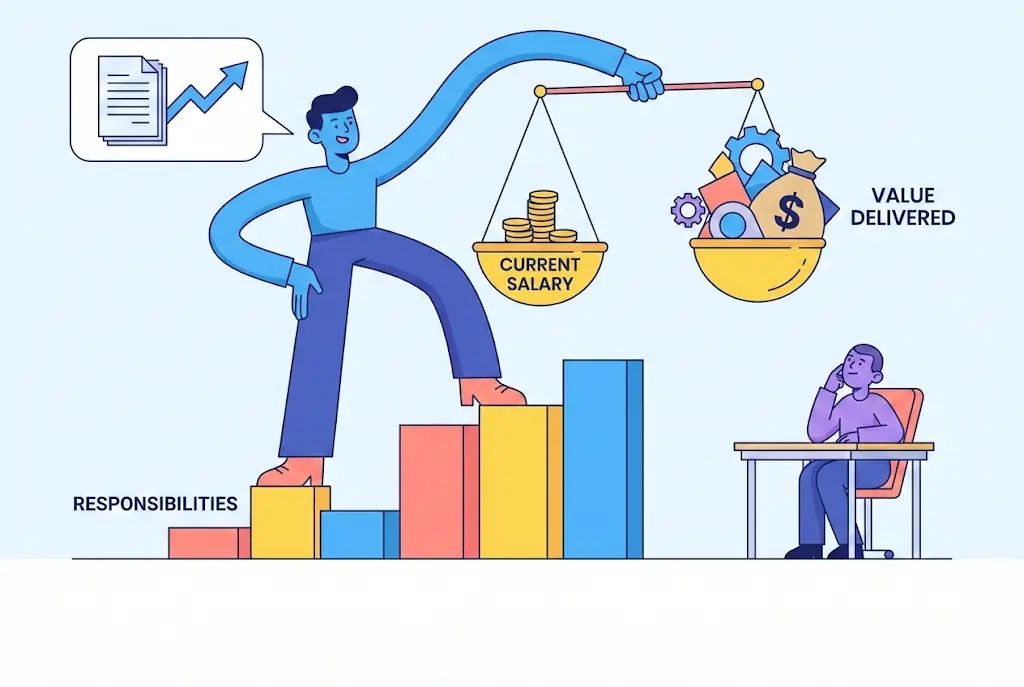
You've been underpaid for a while and you know it. But every time you think about bringing it up, you freeze. Here's exactly how to have that conversation — and why you're not greedy for wanting it.
Dear Peter,
I've been at my company for three years and I'm pretty sure I'm underpaid. I've taken on way more responsibility since I was hired — I basically run our entire onboarding process now, which wasn't even in my original job description. My manager seems happy with my work and I consistently get good reviews.
But every time I think about asking for a raise, I talk myself out of it. I don't want to seem ungrateful or greedy. I don't want to make things awkward. And honestly, I have no idea what to even say.
How do you ask for more money without destroying your relationship with your boss?
— Underpaid and Overthinking It
Dear Underpaid and Overthinking It,
Let me start with the thing you need to hear: asking for a raise is not greedy. It's professional.
You are not asking for a favor. You're not begging. You're presenting a business case for adjusting your compensation to match the value you provide. Companies do this kind of recalibration all the time — they just don't do it voluntarily, because why would they?
The discomfort you're feeling? That's not a sign you shouldn't ask. It's a sign you haven't been taught how. And that's fixable. (This is one of those presence of mind skills — reading the situation and adapting in real-time.)
So let's fix it.
Why you feel weird about it (and why that's normal)
Most of us were raised to believe that talking about money is rude. Add in the power dynamic of a boss-employee relationship, and you've got a recipe for avoidance.
But here's the reframe: your company has a budget for your role. That budget is based on what they think the role is worth. If the role has changed — and it sounds like yours has, significantly — the budget should change too.
This isn't about being greedy. It's about being accurate.
The folks who get paid what they're worth aren't necessarily better at their jobs than you. They're just better at having this conversation. And that's a learnable skill.
Before the conversation: build your case
Don't walk into this meeting with vibes. Walk in with evidence.
1. Know your number
Before you ask for "a raise," figure out what you're actually asking for. Research what your role pays — the role you're actually doing, not the one you were hired for.
Use sites like Glassdoor, Levels.fyi, Payscale, or the Bureau of Labor Statistics to get salary ranges for your title, experience level, and location. If you can find data specific to your industry, even better.
Come in with a range, not a single number. Something like: "Based on my research, the market rate for this role and responsibility level is between $X and $Y." Ranges give both of you room to negotiate. A single number feels like an ultimatum.
2. Document what's changed
You mentioned you've taken on the entire onboarding process. That's your leverage — but only if you make it concrete.
Write down:
- What you were hired to do (your original job description)
- What you actually do now (the expanded scope)
- The impact of that expanded work (how many people you've onboarded, time saved, feedback from new hires, whatever you can quantify)
Numbers are your friend here. "I run onboarding" is less persuasive than "I've onboarded 40 new hires in the last year, reduced time-to-productivity by two weeks, and built the process from scratch." Same work, completely different impression.
3. Gather your receipts
Pull together your recent performance reviews, any positive feedback you've received (emails from colleagues, Slack messages, client compliments), and any metrics that show your impact.
You probably won't use all of this in the conversation. But having it ready does two things: it gives you confidence, and it gives you backup if your manager pushes back.
The actual conversation (a script you can steal)
Here's a framework that works. Adapt the language to sound like you — the structure is what matters.
Open with intent, not a demand:
"I'd like to talk about my compensation. I've been thinking about this for a while and I want to have an open conversation about where I am relative to the market and the scope of my role."
This signals that you're being thoughtful, not impulsive. It also sets the tone as collaborative — you're opening a discussion, not issuing an ultimatum.
Present your case:
"When I started three years ago, my role was focused on [original scope]. Since then, I've taken on [expanded responsibilities], including building and running our entire onboarding program. That's had a measurable impact — [specific results]. Based on my research, the market rate for someone doing this level of work is in the range of $X to $Y, and I'd like to discuss adjusting my compensation to reflect that."
Notice what this does. It doesn't say "I deserve more." It says "the role has changed, the impact is real, and the market data supports an adjustment." That's a business case, not a plea.
Then stop talking.
Seriously. Make your case, then be quiet. Let your manager respond. The instinct will be to fill the silence with qualifiers — "I mean, only if it's possible" or "I totally understand if the budget is tight" — but those qualifiers undermine everything you just said.
You made the case. Let it land.
What your manager might say (and how to handle it)
"Let me look into it and get back to you."
This is the most common response, and it's fine. Say: "That sounds great. Can we set a time to follow up? I'd like to have a clear answer within [two weeks / by the end of the month]." Pin down a timeline so it doesn't disappear into the void.
"The budget is tight right now."
This might be true. It also might be the default deflection. Try: "I understand. Can we talk about what it would take to make this happen — whether that's a timeline, a milestone, or a different budget cycle? I want to know what I'm working toward."
If they give you a clear path ("after Q3 results" or "at your next review in June"), great — you have something to hold them to. If they can't give you anything specific, that's data too.
"You're already at the top of the range for your title."
This is where your documentation matters. "I hear you, and I appreciate the transparency. The challenge is that my responsibilities have grown well beyond the original scope of this title. Can we discuss either adjusting my title to match what I'm doing, or recalibrating the range?"
Don't let a title you've outgrown cap your compensation for a job you've outperformed.
"No."
It happens. And it's not the end of the world. Ask: "Can you help me understand what would need to change for this to be possible?" If the answer is "nothing" — that's important information about your future at this company. You can decide what to do with it. (And if you need help thinking through that decision, well — that's what I do.)
The stuff people get wrong
Timing matters. Don't ask during a company-wide layoff or the week your biggest project missed its deadline. Do ask after a visible win, during a performance review cycle, or when your manager is in a good headspace. Read the room.
Don't use a competing offer as a threat unless you're genuinely willing to leave. Bluffing with an offer you won't take is a gamble that often ends badly. If you do have a competing offer and you'd actually take it, that's a different conversation — and a powerful one. (If you're weighing a move, the career transition guide can help you think it through.)
Don't compare yourself to coworkers. "I know that Alex makes more than me" is a fast track to an uncomfortable HR conversation. Stick to market data and your own contributions.
Don't apologize. "Sorry to bring this up" or "I hope this isn't weird" — cut all of it. You're having a professional conversation about the value of your work. There's nothing to apologize for. You have permission to be good enough — and "good enough" includes advocating for yourself.
Here's the thing nobody says out loud
Companies don't give raises because you deserve them. They give raises because you've made it clear that the current situation doesn't work and you've given them a compelling reason to fix it.
That's not cynical — it's just how organizations operate. Budgets don't adjust themselves. Managers have a hundred things on their plate and your compensation, frankly, isn't top of mind unless you put it there. (If your manager is the Nice Guy type, this goes double — they'll avoid this conversation forever unless you force it.)
So put it there. You've earned it.
Here's Pete's blessing: you are not greedy for wanting to be paid what you're worth. You're not ungrateful. You're not making things awkward. You're doing the professional, adult thing — and the people who do this consistently are the ones whose compensation actually reflects their contribution.
Go get your money.
— Peter
More on this topic → Your career transition handbook
Let's make work suck less.
Got a question for Peter? Submit here or send an email to peter@peterdurlacher.com with the subject line "Dear Peter."