The first-time manager survival guide

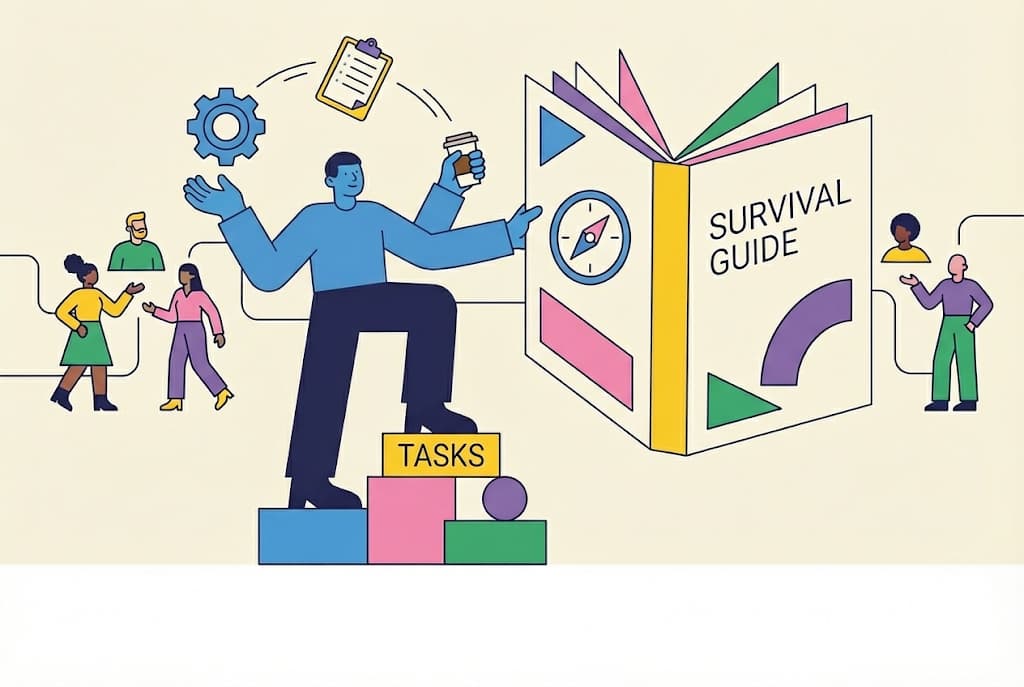
Nobody trained you for this. One day you were great at your job, and the next you're managing the people who do it. Here's everything I wish someone had told me the week I became a manager.
Congratulations. You got promoted.
Now you're sitting in a meeting where someone is crying about a coworker, and you're supposed to know what to do. Yesterday your biggest problem was a tricky spreadsheet. Today you're responsible for another human being's career development.
No one tells you this part. They tell you "you'd make a great manager" and hand you a team and a Confluence page titled "Management Resources" that hasn't been updated since 2019. And then they expect you to figure it out.
I've been there. I managed my first team with roughly the same preparation you'd get for assembling IKEA furniture — a vague diagram, no words, and the creeping suspicion that there were extra pieces. It took me a while, some excellent mentors, and a lot of mistakes to figure out what actually matters.
Here's the guide I wish I'd had.
First, the mindset shift
The hardest part of becoming a manager isn't learning new skills. It's letting go of the thing that got you promoted.
You were probably great at your job. You shipped things, you solved problems, you were the person everyone went to when something was broken. That's why they promoted you.
Here's the uncomfortable truth: the things that made you great at your old job will make you terrible at this one if you don't let them go.
Your job is no longer to be the best at the work. Your job is to make your team the best at the work. Those are completely different things.
This means:
- You'll watch someone do a task slower and differently than you would, and you need to let them.
- You'll sit in meetings that feel unproductive until you realize the meeting was the work — the alignment, the listening, the relationship.
- You'll end days feeling like you "got nothing done" because your old definition of productivity doesn't apply anymore.
That's normal. It gets better. But you have to grieve the old job a little before you can fully show up for the new one.
The stuff that actually matters in your first 90 days
Let me get to brass tacks. Here's what to focus on — and in roughly what order.
1. Build trust before you build anything else
You have a team. Some of them probably wanted your job. Some of them are skeptical. Some of them are just watching to see what kind of manager you'll be.
Your first job is to earn their trust. Not by being their friend — by being reliable, honest, and consistent.
Do this: Schedule a one-on-one with every person on your team in your first two weeks. Not a status update — a real conversation. Ask them:
- What's working well for you right now?
- What's frustrating you?
- How do you like to receive feedback?
- What does your manager do (or not do) that drives you crazy?
Then — and this is the critical part — actually listen. Don't problem-solve in the moment. Don't defend the previous manager. Just take notes and say, "Thank you for telling me that."
You'll learn more in those conversations than in any management book.
2. Set expectations early — especially with your own boss
New managers make two classic mistakes: they focus entirely downward (on their team) and forget they also manage upward (to their boss). Or vice versa.
You need to get clear on what your boss actually expects from you. Not what's on the job description — what they really care about. Ask them:
- What does success look like in six months?
- How do you want me to communicate with you? (Weekly email? Slack? Standing meeting?)
- When should I escalate vs. handle something myself?
- What did the previous person in this role do well? What should I do differently?
Write the answers down. Reference them. This prevents the horrible moment three months later when you find out you've been optimizing for the wrong thing.
3. Don't change anything for 30 days
I know. You have ideas. You see things that could be better. You want to make your mark.
Resist.
Every system you inherited exists for a reason, even if it's a bad reason. Before you change it, you need to understand why it's there. The process you think is stupid might be the only thing preventing a disaster your team dealt with before you arrived.
Spend your first month asking "why do we do it this way?" with genuine curiosity — not "why do we do it this way?" with judgment. The difference matters, and your team will notice which version you're doing.
After 30 days, you'll have enough context to make informed changes. And your team will trust you enough to come along for the ride.
4. Learn to give feedback (the real kind)
This is the skill that separates decent managers from great ones. And it's the one most new managers are worst at.
I've written about the Nice Guy boss problem — the manager who's pleasant but useless because they can't give honest feedback. Don't be Gary.
Here's the formula that works:
Situation → Behavior → Impact.
Not "you need to communicate better" (vague, unhelpful). Instead: "In yesterday's client meeting [situation], you interrupted Maya twice while she was presenting [behavior], and it made the client visibly uncomfortable and undermined Maya's credibility [impact]."
That's feedback someone can actually use.
A few rules:
- Give feedback within 48 hours. Stale feedback is useless.
- Positive feedback is just as important as corrective. Don't only show up when something's wrong.
- Be specific. "Great job" is not feedback. "The way you structured that proposal made it really easy for the client to say yes" is feedback.
- Do it in private unless it's praise (praise in public, critique in private — always).
5. Protect your team's time and energy
One of the biggest things you can do as a manager — and one of the least obvious — is be a shield.
Your team will be bombarded with requests from other departments, last-minute "urgent" projects, and meeting invitations that have no business existing. Your job is to filter that noise so they can do their actual work.
This means learning to say no. Or, more diplomatically, learning to say "not right now" or "let me understand the priority before I commit my team."
This is terrifying at first, especially if you're a people-pleaser. But your team will notice immediately when you start protecting their time. It's one of the fastest ways to build loyalty.
6. Run good one-on-ones
If you do nothing else on this list, do this one. Regular one-on-ones are the single most important management practice.
Weekly or biweekly. 30 minutes minimum. And — this is crucial — it's their meeting, not yours.
That means you don't show up with a status update agenda. You show up and ask: "What's on your mind?"
Then you listen.
Some weeks it'll be about work. Some weeks it'll be about a conflict with a coworker. Some weeks it'll be about something personal that's affecting their focus. All of that is valid.
Your role in a one-on-one is three things:
- Listen to what they're dealing with.
- Coach them through it (ask questions before offering answers).
- Remove obstacles they can't remove themselves.
The biggest mistake new managers make with one-on-ones is canceling them when things get busy. Don't. The busier things get, the more your team needs that protected time with you.
Common first-time manager mistakes (and how to avoid them)
I've made all of these. Learn from my pain.
Doing the work yourself instead of delegating
When something is urgent and you know you could do it faster yourself — the temptation is overwhelming. Don't give in (most of the time). Every time you do the work instead of teaching someone else to do it, you're creating a bottleneck and stunting their growth.
The exception: If the building is literally on fire — metaphorically — jump in. That's what leaders do. But if it's Tuesday and the report is due Thursday, let your team handle it.
Trying to be everyone's friend
You can be friendly without being friends. You can care about your team without going to happy hour every week. The moment you need to give someone tough feedback or make a decision they don't like, the friend dynamic becomes a liability.
Be warm. Be approachable. Be human. But remember that your job is to make them better at their jobs — not to be popular.
Avoiding difficult conversations
The longer you wait to address a performance issue, the worse it gets. I know it's uncomfortable. I know you'd rather just hope it resolves itself. It won't.
The most generous thing you can do for an underperforming team member is tell them clearly, specifically, and early — so they have a chance to fix it. Silence isn't kindness. It's a delayed firing.
Micromanaging (because you're anxious)
New managers micromanage because they're scared. If something goes wrong, it's on them now. So they hover, check in constantly, and review everything twice.
Your team feels this. It communicates "I don't trust you." Even if that's not what you mean.
The fix: Define the outcome you need, agree on check-in points, and then get out of the way. If the result is 80% of what you would have done — that's great. Seriously. 80% is great.
Not asking for help
Here's Pete's blessing: you don't have to figure this out alone.
Talk to other managers. Find a mentor — someone who's been doing this longer and can tell you what's normal and what's not. Read Beyond lip service: what real mentorship looks like for more on why this matters.
And if you want structured support from someone who's been in your shoes, that's what coaching is for. Here's how we work together →
The bottom line
Being a first-time manager is hard. Not "challenging in a growth-mindset way" hard — actually hard. You'll feel incompetent, you'll second-guess yourself, and you'll have days where you wonder why you didn't just stay as an individual contributor.
That's normal. It doesn't mean you're bad at this.
The managers who end up being great are the ones who are honest about what they don't know, who listen more than they talk, and who care more about their team's success than their own ego.
You're already reading a guide about how to be better at this, which means you care. That's more than half the battle.
Now go schedule those one-on-ones.
More on this topic → The real guide to management & leadership
Let's make work suck less.