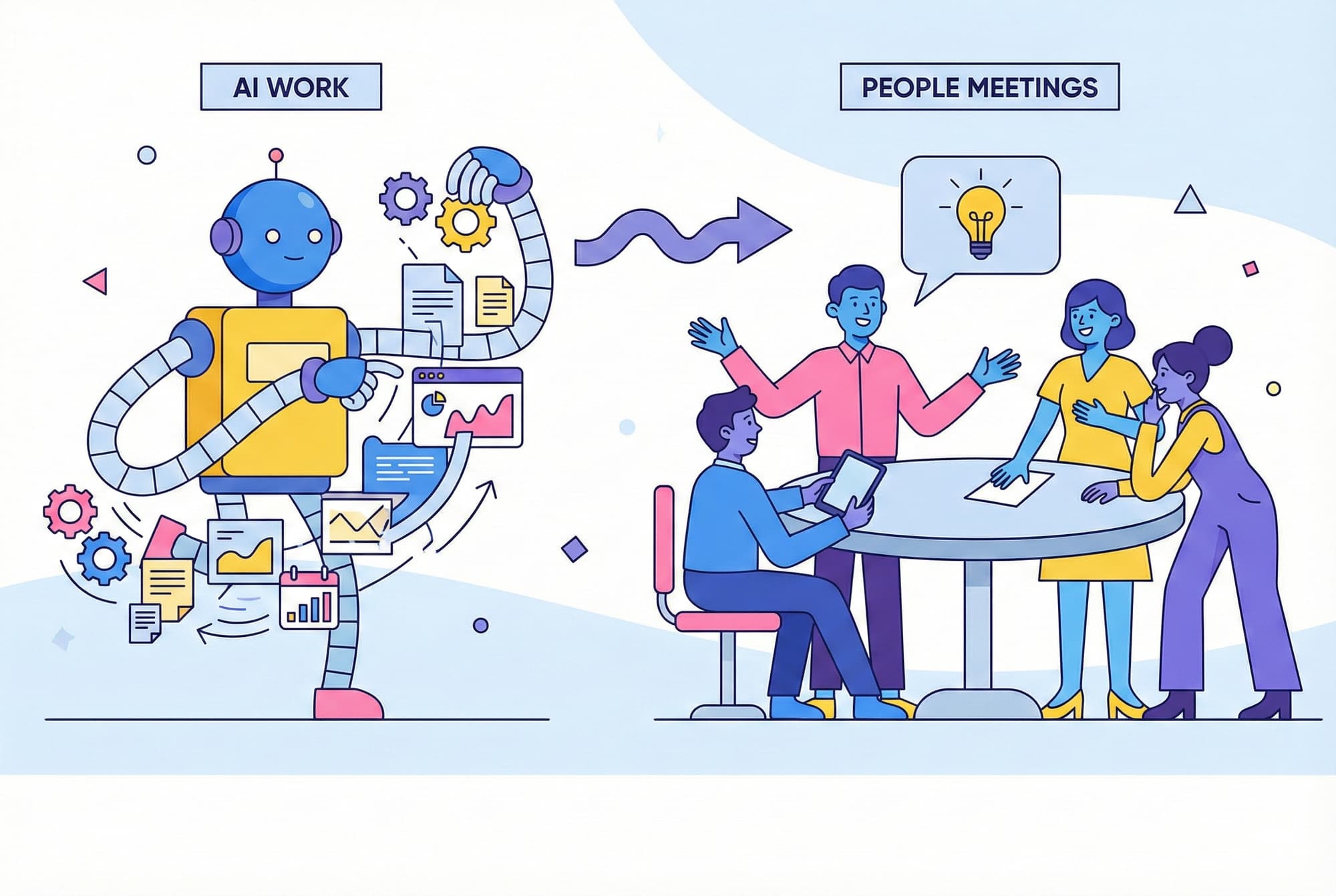
Let AI be the robot. Meetings are for people.

TLDR: It's okay if a meeting could have been 10 minutes or an email or any other "more efficient" package. Rounding up to 30 minutes so you get a moment to connect is okay. The relief you get from a casual conversation will actually let you focus more deeply afterward. You just have to give yourself permission to enjoy it.
If you're like me, you probably don't resent meetings. At least not all meetings.
Yes, there are times where it makes sense to "protect your calendar", and some folks are less pleasant to work with than others. But to treat "banter"—the jokes, the shared frustration, the 10-minute tangent about a weird documentary—as "waste"? That's a damn shame.
Because for better or worse, the "waste" is usually the most enjoyable part of the job.
The problem isn't the meeting. The problem is the mental tax we pay while we’re in it. We’re half-listening because we’re half-typing notes. We’re stressed about capturing action items instead of actually hearing the nuance in a teammate’s voice.
In 2026, let AI be your Digital Archivist. They can take the notes now, so you can review what's important later.
In the meantime, listen to Doug's story about how he survived a grizzly bear attack in the winter of '82.
The freedom to "waste" time
When you have an archivist running in the background, your relationship with work changes. You no longer have to be a human recorder.
- Permission to Banter: If you know the AI is capturing the "business outcomes" and the "next steps," you can take the efficiency gained and afford to spend the first ten minutes of the call talking about your kid's soccer game or how when your dog sleeps in the bed, it changes the entire physics of the sheets. That isn't "lost time"; that’s the glue that makes a team a team.
- The Joy of the Meeting: If your job is meetings, that’s okay! Meetings are where the energy is. They are where creativity comes out. When the archivist handles the post-meeting summary, you can stop staring at your notepad and start looking at people’s faces. You can be fully present.
Don't optimize away the humanity
The danger of the AI era is to assume that every ounce of efficiency bought by AI needs to be spent on more work. We think that if AI saves us an hour, we should use that hour to do more tasks.
Pete says no. Use that hour to have a longer lunch with a friend. Use it to go down a creative rabbit hole that has no "deliverable." Use it to stay on the Zoom call for an extra five minutes just to check in on a coworker who looked a little stressed.
Utilizing the time freed up by AI to connect and refresh rather than just double down on work is going to make it so you're less burnt out, more connected to folks you work with, and more likely to stick around.
And yes, for the folks keeping track: it's a net benefit to your productivity when time and energy aren't treated like such scarce resources.
How to use your archivist:
- Take notes, Claude: Let the AI record and summarize everything. Don't do it to "be more productive"—do it so you can focus on the conversation now. You'll feel that much more compelled to help when you feel connected to the folks you're helping.
- Give it a go, Gemini: Use AI to handle the "administrative dread"—the standard follow-up emails, the project updates, the status reports. These tasks aren't "work"; they’re the fee we pay just to do the consequential work. When the archivist pays the fee, you get to keep the profit: your time and your sanity.
- Let's talk, Doug: Next time someone says, "Sorry, we’re getting off track," try saying: "All good, Doug. Tell me again how you actually ended up taming the grizzly and living off its warmth through the harshest blizzard of the last century."
It's okay for a meeting that "could have been an email" to be 10 minutes "on topic" and 20 minutes of shooting the breeze. Sometimes the ratio will be 10:20, 30:0, or 0:30, but all of those are valid.
Small talk isn't a waste of time—it's an opportunity for fun and connection.
We don’t want a world where we work 10x faster. We want a world where work sucks 10x less. AI is the tool that finally allows us to stop acting like machines. It handles the repetitive, the data-heavy, and the soul-sucking documentation. That leaves us with the stuff machines are terrible at: empathy, humor, spontaneity, and connection.
So let the archivist take notes. You’ve got a conversation to finish.
Looking to make work and life a little more balanced? Check the guide for making it happen.