Permission to be "Good Enough"

Hey y'all, this one's a bit of a two-parter:
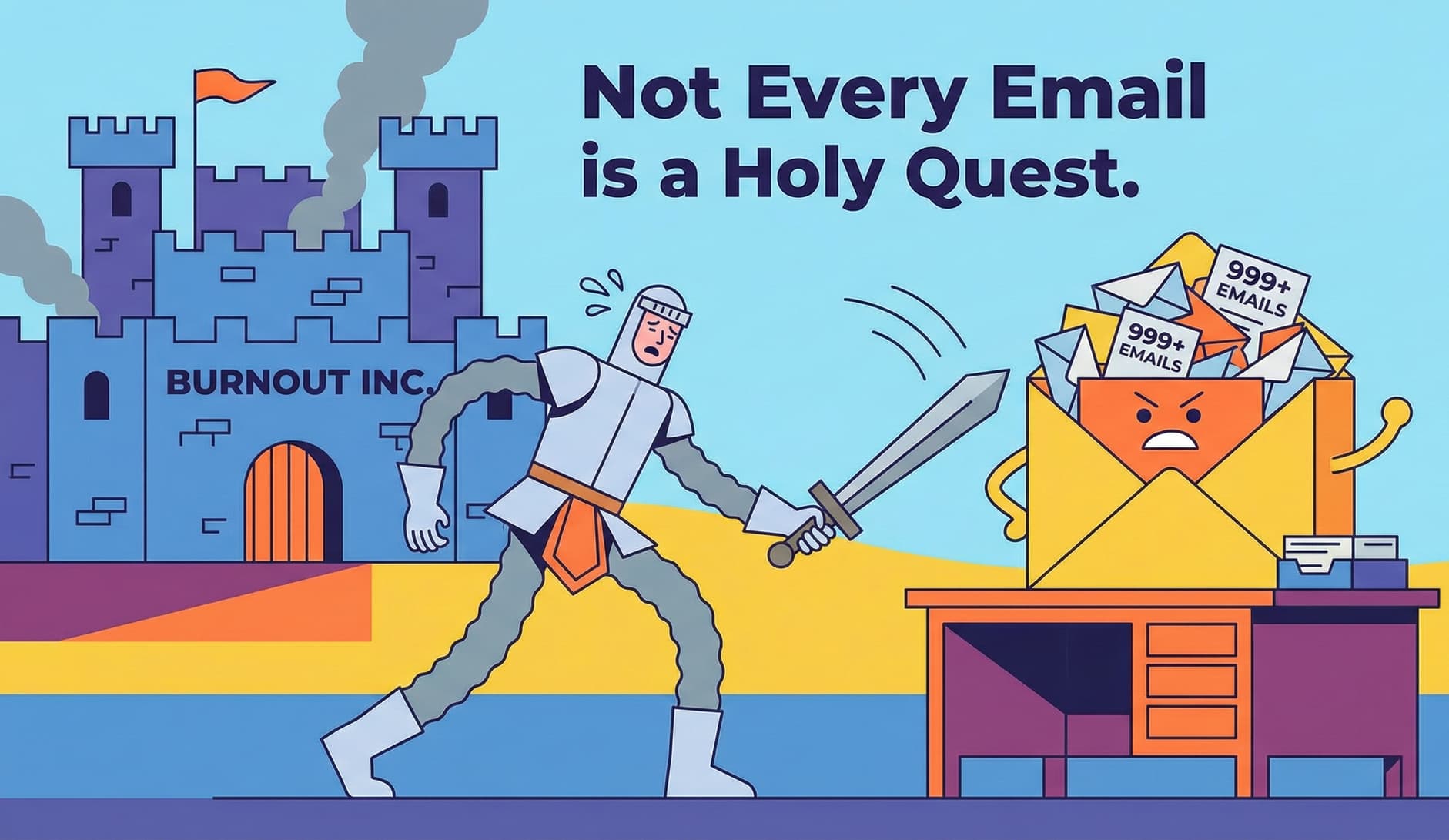
- First, I talk through disarming the idea of "excellence" in corporate culture. We don't need burnout for excellence. And it's not excellence if it's upscaled exploitation.
- Second, I lay out how you can do good work without treating every task like a holy quest. It's okay to manage your energy so that you pay more attention to the content of a client presentation than the font on an internal memo.
With that context, let us begin.
Disarming "excellence"
"Always give 110%."
"'Work-life balance' is a load of nonsense. Elite performance requires an intense commitment."
"996 is a joke. It doesn't even come close to what it actually takes."
We've all heard the first one, and certainly some flavor of the last two. They are ..something. Truly something.
There's a world of difference between saying "if you're down for it, great!" and the insinuation that only folks that put in everything, all the time are going to achieve anything of value or consequence.
I might even agree that the American corporate world can only support fledgling businesses that use people's wellbeing for fuel to get past a certain hump of viability. That is, to an extent, how the system is set up.
But the idea that, in order for something of value to be achieved, you must give your life, as if it's a natural law, a physical necessity, is bogus.
Frankly, venture capital is the perfect counter: Uber, DoorDash, etc.—countless startups—have been absolutely burning money on services that in the best case only "create value" via arbitrage.
Without a sugar daddy paying their bills, they wouldn't be able to have gotten anywhere. It's hard to argue it's a "superior product" when it only got a foothold by creating artificially low-priced offerings for services that already existed (eg: taxis).
Only once they starve out the competition can they approach profitability—and even then, only by strongarming the actual service providers into lower wages (and raising prices by wild sums to finally reflect the cost of those services).
Amazon, the dominant e-commerce marketplace, only continues to exist because it has a separate web services business that prints money. So it burns daddy Bezos' funds to price out its competitors and terrorize its workers, then claims it's offering a better product.
But that's not a financially-viable, superior product. That's a middle school bully taking other kids' lunch money because his brother's in high school.
So, to scream that urgency and cortisol injections are the only way to achieve excellence is inherently flawed, because the companies shouting the loudest about it are the ones propped up by a separate fount of cash.
If the end goal is to kill the competition with artificially low prices, then raise prices on a cornered market, you're not building "something great"—that "thing" looks exactly like what it replaces, just less humane.
Imagine what businesses might have survived, what products might have been created, what innovation and synergy (going for the buzzword crowd) might have been if, instead of pouring money on companies whose whole business model is predicated on hiding the true price of its products, we instead divvied out those investments more judiciously so that more companies can prove their viability before going under.
Maybe, just maybe, folks wouldn't have to get a divorce, an ulcer, and a drinking problem, all to create an empire that forces its workers to piss in jugs, so that some schmuck in Columbus, Ohio gets their Labubu the same day they heard of it.
How to do good work, reasonably
The intro above serves to say: every example of "excellence" that demands outlandish self-sacrifice is just an abusive parent making their kids fight each other for dinner.
There is enough dinner for everyone, we don't need to fight for our scraps.
To be clear, we can absolutely take pride in our work and do a good job. It is okay to enjoy your work. It's certainly preferable to hating it.
But instead of a horrid grind as the only way to earn a decent living, I offer you an alternative: Strategic Mediocrity.
It sounds bad, I know—but the idea is once again not about ignoring commitments or "slacking off". It’s about resource management. It’s the realization that you have a finite amount of oomph in you each day, and if you spend it all perfecting the font on a weekly status report that three people will skim, you’ve got nothing left for the stuff that is of actual consequence.
Procrastination + Perfectionism = ..Procastonism?
Perfectionism is just procrastination in a fancy suit. It’s a defense mechanism. If we make it "perfect," nobody can criticize us, right?
But perfection is a moving target, and chasing it is what makes work feel like an endless treadmill. When everything is a priority, nothing is a priority. When everything has to be "excellent," you end up exhausted, cynical, and—ironically—less effective at your job.
Map it out
To make work suck less, we have to discern between different types of tasks. Not everything needs your best self. Some tasks just need to be finished.
| Category | Goal | Effort | Example |
|---|---|---|---|
| Important / enjoyable | "Excellence" | 100% | Creative problem solving, mentoring, "big" client pitch, etc. |
| Middle ground | Being clear | 70% | Project plans, internal docs, etc. |
| Administrative | Just being done | 30% | Expense reports, "circling back" emails, data entry, etc. |
Let's go bottom up here:
Administrative
Use tools that get those bottom-tier tasks to "Good Enough" quickly. Don't spend thirty minutes perfecting the tone of a meeting invite. Great candidate for AI to handle.
Middle ground
Use AI for a first draft, sure—then dedicate some time to editing it. The goal here is clarity: these internal items are not going to be scrutinized by big-wig clients or execs. Rather, these are items you're sharing with peers, your manager, etc.
If your company doesn't have templates for what you're making, it's okay for some graphics to be a few pixels off. Not every character needs to be accounted for. You want the ideas and concepts to come through, but it's not worth chewing your fingernails over.
Important / enjoyable
Here we go, here we go, satellite radio: the biggest and best reason to embrace "good enough" is so we have the energy to be present when it counts. If you aren't obsessing over the "perfect" delivery of your update in a meeting, you might actually have the mental space to:
- Listen to the subtext of what your coworker is saying.
- Crack a joke that breaks the tension in a high-pressure moment.
- Actually enjoy the conversation instead of just waiting for your turn to perform.
When you give yourself permission to be "good enough" at the boring stuff, you find you have the capacity to be excellent at the stuff that gives you vitality (whether from doing good work in its own right, or because you just do like the work).
What if my boss demands 110%?
If you work for a manager posting to LinkedIn about radical candor and demanding excellence—the one who thinks a typo in an internal memo is a capital offense—the "good enough" strategy is even more vital.
- The Move: Apply your excellence to the things your boss actually cares about (the metrics, the big wins) and quietly automate or "good enough" the rest.
- The Mindset: You aren't lowering your standards; you’re being a professional athlete who knows which games are the playoffs and which ones are just practice.
And if this manager continues to harp, even after addressing the question with them directly, maybe it's not about performance.
Maybe they just suck. Maybe you quit. Or transfer.
Pete's blessing
I am officially giving you permission to ship that "B-minus" draft. I am giving you permission to stop formatting that spreadsheet once it’s readable. I am giving you permission to close your laptop at 5:00 PM even if there’s still "stuff" to do.
Work will always be there tomorrow. Your energy, your humor, and your ability to connect with the people around you? Those are the things that are actually in short supply.
Excellence is a tool. Use it sparingly. "Good enough" is a superpower. Use it daily.
Looking to make work and life a little more balanced? Check the guide for making it happen.